In 17th century New England, Christmas was not even a holiday. In fact, in 1659 the Puritan government of the Massachusetts Bay Colony actually banned Christmas, enacting a law that levied a fine on anyone who was ‘found observing any such day as Christmas or the like, either by forbearing of labor, feasting, or any other way.’ This punishment remained on the books until 1681, when it was repealed due to pressure from Anglican England.
Hard to believe, because at the time Christmas in 17th-century England actually wasn’t so different from the holiday we celebrate today. However, the Puritans who fled the persecution of the Anglican majority felt that such celebrations were unnecessary and distracted from religious discipline. This meant that Christmas wasn’t the only holiday that was forbidden, but Easter was well. Bans like these would continue into the19th century. The U.S House of Representatives even convened on Christmas in 1802. Eventually, as Puritanism started to fall out of favor, Christmas was almost universally accepted throughout the United States by 1840, and it was eventually declared a National Holiday in 1870.
In the shaping of how Christmas is celebrated today, there are several Rhode Islanders who played considerable roles. Two of them are Ann and her husband James Franklin, a printer and brother of founding father, Benjamin Franklin. In the early 1720s, Anna and James published almanacs in which they boldly identified December 25 as Christmas Day. The Puritans rejected this arbitrary date as Christ’s birthday, as they rejected anything that was not directly commanded or reported in Scripture. For printing his opinion in his newspaper, the New England Courant, James Franklin was briefly jailed. Like other Massachusetts dissenters, he and Ann sought greater liberty in nearby Rhode Island. They came to Newport in 1726 to exercise their freedom of the press by printing the colony’s first newspaper, the Rhode Island Gazette.
Two other Rhode Islanders helped shape the modern observance of Christmas in more subtle ways. Clement Clarke Moore (1799-1863), an American writer, scholar and real estate developer, is credited with writing a children’s Christmas poem he called ‘A Visit from St. Nicholas,’ routinely referred to as ‘The Night Before Christmas’ or ‘Twas the Night Before Christmas.’ The work is cited as being the first to name each of Santa’s reindeer.
The poem was first published anonymously under the title, ‘Account of a Visit from St. Nicholas’ in 1823. Authorship has been attributed to Moore, who claimed the poem as his in 1837, though some have suggested that Henry Livingston Jr. may have written it.
This descriptive Christmas poem has been called “arguably the best-known verses ever written by an American,” and is largely responsible for many of the conceptions of Santa Claus that we have today. Before ‘A Visit From St. Nicholas’ gained wide popularity, the ideas that Americans had about how Santa Claus looked and act varied considerably.
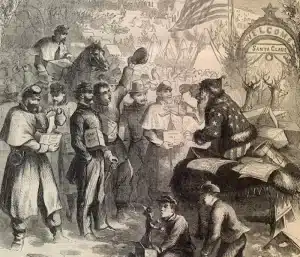
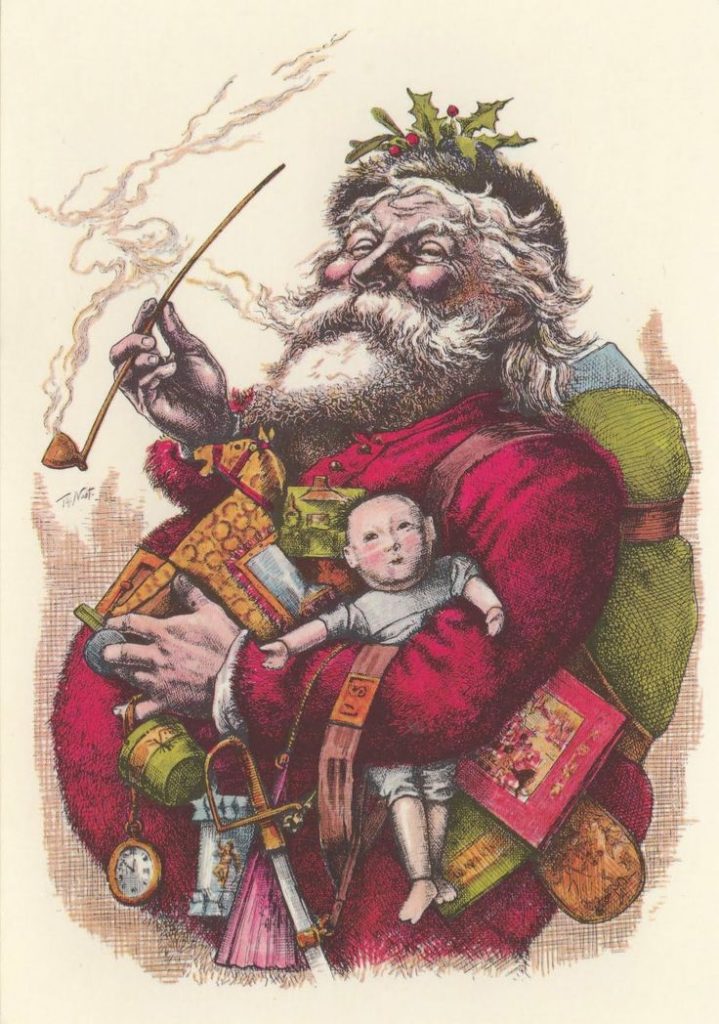
At the end of Moore’s life, Thomas Nast, known as the ‘father of modern political cartoons,’ forever popularized the appearance of the St. Nicholas described by Moore in his famous verses. The combined talents of these two men produced the iconic image of the Santa Claus we all know today after Nast’s drawings of old St. Nick first appeared in a January 3, 1863 edition of Harper’s Weekly. At that time, the magazine was edited by Providence-born George William Curtis. Curtis was the grandson of U.S. Senator James Burrill, for whom the Rhode Island town of Burrillville was named.
According to Patrick T. Conley, President Emeritus of The Rhode Island Heritage Hall of Fame and Rhode Island’s historian laureate, George Curtis was enshrined in The Rhode Island Heritage Hall of Fame in 1973, and Clement Moore joined him in 2004.
HAPPY CHRISTMAS TO ALL, AND TO ALL A GOOD-NIGHT!