The Most Expensive Office Technology Purchase You’ll Ever Make Is Usually the Cheapest One
Everyone loves a good deal.
When it’s time to replace office equipment or evaluate a new technology partner, one of the first questions we hear is:
“Can you beat this price?”
It’s a fair question.
But it’s often the wrong one.
Because when you compare quotes, you’re rarely comparing everything.
You’re comparing numbers on paper—not the experience you’ll have for the next five to seven years.
Since 1992, A Lot Has Changed
Automated Business Solutions opened its doors in 1992.
Back then, businesses relied on filing cabinets, fax machines, handwritten approvals, and paper invoices moving from desk to desk. If someone needed a document, chances are they were digging through a file cabinet. Approvals often meant walking paperwork from office to office and hoping it eventually landed on the right person’s desk.


Fast forward more than three decades, and the technology available to businesses has changed dramatically.
Yet many organizations are still relying on the same manual processes they used in 1992.
For more than 30 years, we’ve worked with businesses throughout Rhode Island, Massachusetts, and Connecticut, and one thing hasn’t changed: every company wants the best value for their investment.
What has changed is what “value” really means.
Today, value isn’t just the monthly payment on a copier lease.
Browse Our Latest Magazine Monthly Issues



It’s the efficiency of your employees.
It’s your cybersecurity.
It’s your document management.
It’s your workflows.
It’s how quickly your team can get back to work when something unexpected happens.
Before We Talk About Price…
When someone asks us to beat another quote, our first response usually isn’t another number.
It’s a conversation.
We want to understand how your business operates.
How do your employees work?
What happens if your network goes down?
What happens if your copier is offline for a day?
How much time does your team spend searching for documents?
What processes are still handled with paper?
Whether we’re discussing office equipment, managed IT services, document management, or workflow automation, our goal is the same: understand how your business works before recommending a solution.
Because the right solution for one company may not be the right solution for another.
What Happens After the Ink Dries?
The real cost of office technology isn’t the monthly payment.
It’s what happens after the equipment is installed.
How quickly can you reach someone when you need help?
How long will your employees be unable to print or scan?
Who is helping if your workflow stops before payroll is processed?
Who is responsible for implementation and training?
What happens if your network goes down?
How much does one day of downtime cost your business?
Those questions rarely appear on a quote.
Yet they’re often the most expensive part of the decision.
Sometimes, after learning more about a customer’s environment, we discover that another proposal didn’t account for everything that was included in ours—implementation, lease buyouts, managed services, supplies, workflow software, training, or ongoing support.
The lowest number isn’t always the lowest total cost.
You’re Not Buying a Copier
Today’s office technology is connected to nearly every part of your business.
Invoices.
Customer records.
Purchase orders.
HR documents.
Cloud storage.
Cybersecurity.
Printing.
Scanning.
Business applications.
Artificial Intelligence.
Workflow automation.
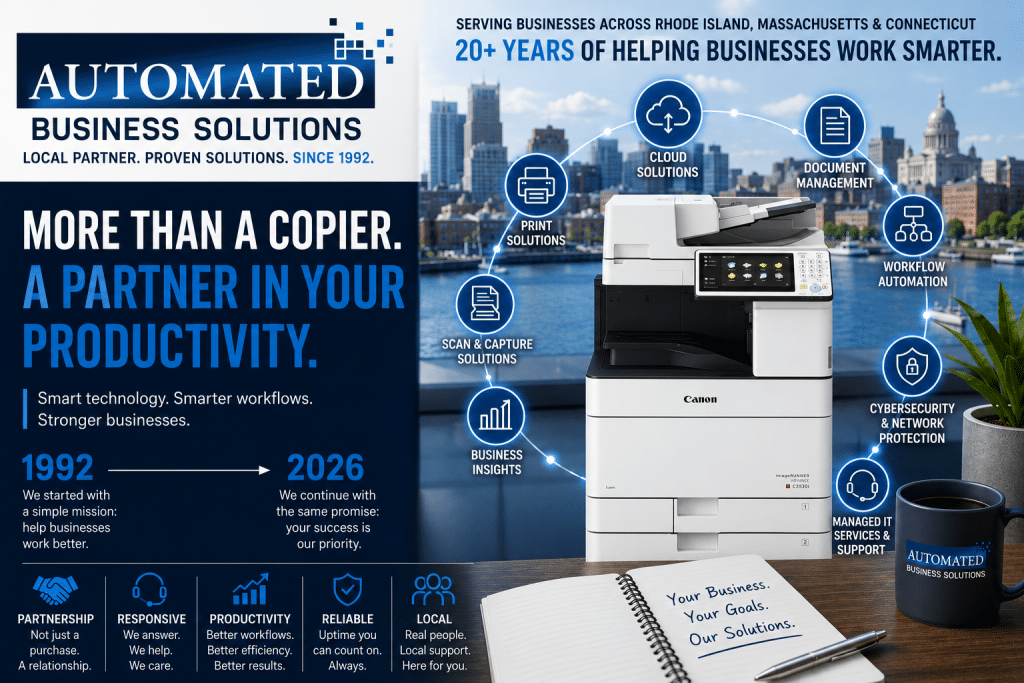
A copier isn’t just a copier anymore.
It’s often the hub of how information moves throughout your organization.
If your technology partner is only focused on selling hardware, you may be missing opportunities to improve how your business operates every single day.
Technology Should Remove Work
One of the biggest opportunities many businesses overlook isn’t replacing equipment.
It’s eliminating unnecessary work.
Imagine if…
Vendor invoices automatically routed to the right approver.
New employee paperwork notified HR, IT, and managers automatically.
PTO requests followed an electronic approval process.
Expense reimbursements no longer bounced from desk to desk.
Customer files became searchable in seconds.
Sales paperwork automatically moved from order entry to billing to processing without someone manually tracking each step.
Managers could instantly see where a document was in the approval process instead of wondering who had it last.
These aren’t futuristic ideas.
Businesses are using these workflows today to save time, reduce errors, improve visibility, and keep work moving.
A Partnership, Not Just a Purchase
Price absolutely matters.
We’re not suggesting it doesn’t.
But before making your decision, ask yourself a few questions.
Who answers the phone when we need help?
What happens if we’re down tomorrow morning?
Who handles implementation?
How are our employees trained?
Will this solution grow with our business?
What kind of relationship will we have after the sale?
Those answers often determine whether the lowest quote actually becomes the most expensive one.
Looking Ahead
Since 1992, we’ve watched office technology transform from simple copiers into business productivity platforms.
The businesses that thrive over the next decade won’t necessarily be the ones with the newest equipment.
They’ll be the ones using technology to eliminate unnecessary work, automate routine tasks, improve security, and keep their employees focused on what they do best.
If your organization is still routing paper invoices by hand, chasing signatures, or searching through filing cabinets for important documents, it may be time to rethink how work gets done.
Because while 1992 was a great year…
It’s probably not the best year to model your business processes after.
Jennifer Thomson
Vice President of Marketing & Philanthropy
Automated Business Solutions
Warwick, Rhode Island
www.absne.com